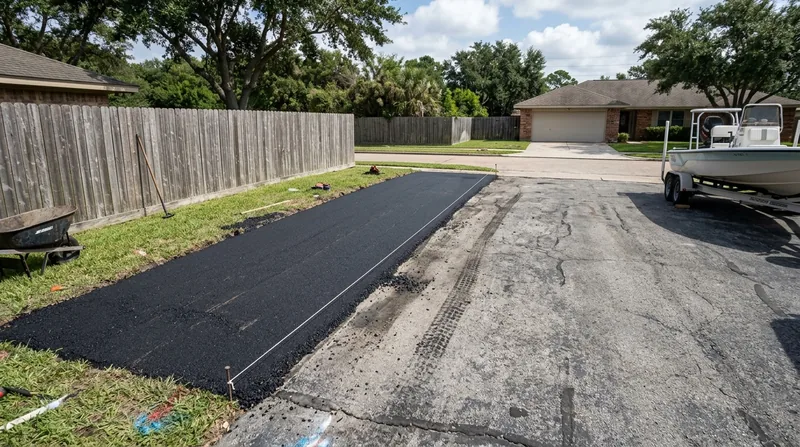




Houston's ribbon driveways and tight motor courts need room to grow. Whether you're adding a pad for the boat, the third car, or an RV, or rebuilding a broken apron where your driveway meets the street, driveway extensions, widening and aprons are the practical answer to a property that's outgrown its original footprint. The black gumbo clay, the heat, and fifty-plus inches of tropical rain that ponded on flat lots have cracked and settled thousands of driveways across the Heights, Meyerland, Katy, The Woodlands, and Pearland. Many of those same properties now need more pavement, not just repair. We add parking pads, widen tight ribbon drives in the historic neighborhoods, rebuild failed aprons that the city requires before the street meets your asphalt, and tie every extension into your existing surface with milled seamless joints. Small-footprint jobs with full-size compaction standards.
Why Driveway Extensions and Widening Matter in Houston's Tight Lots
Houston's oldest neighborhoods were laid out on narrow lots. The Heights, Montrose, and the Museum District still hold 1900s and 1930s bungalows and Victorians with ribbon drives just wide enough for one car and detached rear garages a long walk away. Many homeowners now own two or three vehicles and need a place to park without blocking the street. Meanwhile, Meyerland and the older suburbs saw Harvey flood in 2017, and many raised homes or rebuilt structures shifted the footprint of the driveway apron or left it cracked and broken. Adding width, extending the pad, or rebuilding the apron to meet municipal code is the fix.
- Ribbon drives in historic Houston neighborhoods are often 9 to 11 feet wide, built for one 1950s sedan, and cannot hold two modern vehicles without one overhanging the street.
- Aprons (the section where your driveway meets the street curb or right-of-way) are regulated by the city and must meet grade, slope, and width standards before we can tie new pavement into it.
- RV and boat pads require a flat, stable base and proper drainage so the weight does not sink or crack after the first heavy rain.
- Extending a driveway into a side yard or adding a turnaround requires grading, proper compaction, and a seamless joint with the existing asphalt so water does not pool at the seam.
- HOA rules in master-planned communities like The Woodlands, Sugar Land, and Pearland often govern the material, width, and finish of any driveway extension, and those rules must be verified before the estimate is locked in.
Every extension we build carries the same compaction standards and thickness as a new driveway, so it holds under Houston's heat and rain for years.
Key info: The city of Houston and the surrounding villages (Bellaire, West University, Piney Point, Bunker Hill, and others) all require a permit for driveway apron work because the apron sits in the public right-of-way. Verify with your municipal building department before you book, and confirm whether your HOA has architectural review. We help you navigate the permitting process.
For more on how aprons and base preparation work together, see our page on asphalt driveway paving and installation.
How We Build Driveway Extensions, Widening, and Aprons in Houston
Every extension or apron rebuild starts with a site visit and a clear understanding of what the city or your HOA requires. We measure, check the slope, verify the subgrade, and make sure the new asphalt ties seamlessly into the old. The gumbo clay beneath most Houston properties needs proper preparation so the new pavement does not settle or crack where it meets the existing drive. We mill the edge of your old asphalt to create a clean, keyed joint, grade and compact the new base, and lay the new asphalt in a single pass so the seam is invisible and watertight.
- We locate underground utilities with a Texas 811 call before any excavation begins, as required by law.
- We grade the new area to proper slope so water sheds away from the house and does not pond on the pad.
- We compact the base to 95 percent density with a vibratory roller, the same standard used for commercial parking lots.
- We mill the edge of your existing driveway to expose fresh asphalt and create a mechanical bond for the new material.
- We lay the new asphalt course and roll it hot so the seam fuses and the surface is even and smooth.
- We provide written tonnage specs and an estimate that shows the square footage, thickness, and material we will use.
The result is an extension that looks and performs like part of the original drive, not a patch or a bolt-on.
Local example: A Meyerland homeowner needed to widen a 10-foot ribbon drive to 18 feet to park two vehicles safely. The existing asphalt was sound, so we added 8 feet of new pavement on the side, milled the joint, and compacted a 4-inch base with lime-stabilized subgrade to handle the gumbo clay. The total pad was 450 square feet and took two days. Cost started at $2,400.
For details on how we handle base prep and grading, see gravel driveway installation and grading.
Methods and Approaches for Driveway Extensions and Aprons
| Approach | Description | Best for |
|---|---|---|
| Milled Joint Extension | We mill the edge of existing asphalt, grade and compact new base, and lay new asphalt hot to fuse the seam. Tonnage and thickness are specified in writing. | Adding width, parking pads, or turnarounds where the existing drive is sound and can be tied into cleanly. |
| Full-Depth Apron Replacement | We remove the failed apron section completely, re-grade to proper slope and elevation per city code, compact a new base with lime-stabilized subgrade, and lay new asphalt to spec. | Broken aprons, settled sections, or aprons that do not meet municipal grade or width requirements after a rebuild. |
| RV and Boat Pad Installation | We build a dedicated pad with reinforced base, proper drainage, and a level finish capable of supporting concentrated wheel loads. Turnouts and pull-through layouts are designed on site. | Adding a dedicated parking space for RVs, boats, or heavy equipment that cannot share the main driveway. |
| Turnaround and Cul-de-Sac Paving | We grade and pave a turning radius that allows vehicles to exit without backing into the street, with proper slope and edge definition. | Long or narrow driveways where a three-point turn is not practical, or private roads where turning radius is required. |
Driveway Extensions, Widening, and Aprons Cost in Houston: What to Expect
A basic driveway extension or widening in Houston starts at $1,800 for a small pad (200 to 250 square feet) with a straightforward milled joint and no complicated grading. The cost moves up based on the size of the pad, the condition of the subgrade, whether the existing asphalt needs milling or removal, and the distance from our yard. An apron replacement that requires full-depth removal and re-grading to meet city code can run $2,500 to $4,500 depending on the size and the slope adjustment needed. RV and boat pads with reinforced base and drainage typically run $3,000 to $6,000 because they require thicker compaction and often sit on difficult clay. A turnaround on a private road can be $4,000 to $8,000 or more if grading is extensive.
The biggest cost variables are the footprint (square footage), the condition of the gumbo clay subgrade beneath, whether we need to mill or remove existing pavement, and site access. A pad in a tight side yard where a roller cannot fit costs more than the same pad in an open lot. If the clay is saturated or has been disturbed by tree roots or settlement, we may need to lime-stabilize it, which adds material and labor. We always provide a written estimate with tonnage and thickness so you know exactly what you are paying for. For a detailed breakdown, see our pricing overview.
Get 2 or 3 estimates from local contractors. Verify that each estimate includes the square footage, the thickness of asphalt and base, the tonnage, and the method for tying the new pad into the existing drive. A price that sounds too good often means the base prep is being skipped or the thickness is less than standard, and that pad will crack and settle within a year or two.
Driveway Extensions, Widening, and Aprons Near Me: What Houston Homeowners Should Know When Hiring
Asphalt paving and driveway work are not licensed trades in Texas at the state level, but your city does regulate contractors and driveway apron work in the right-of-way. The city of Houston requires contractors to register and obtain a permit for apron and curb-cut work. Villages like Bellaire, West University, Piney Point, and Bunker Hill have their own permitting offices and may require proof of insurance and a local contractor registration. Before you hire anyone, verify that the contractor is fully insured, ask for references, and check that they understand your local permitting requirements. Many homeowners in master-planned communities like The Woodlands, Pearland, and Sugar Land also have HOA architectural review, and that approval must come before the work begins.
- Call your city or village building department and confirm whether a permit is required for your driveway apron or extension.
- Ask your HOA (if you have one) whether driveway extensions require architectural approval and whether there are restrictions on material, width, or finish.
- Request a written estimate that includes square footage, asphalt thickness, base thickness, tonnage, and the method for tying into existing pavement.
- Ask for at least two references from recent jobs in your neighborhood or a similar soil and climate zone.
- Verify that the contractor carries liability and property damage insurance and ask to see the certificate.
- Never pay a large cash deposit upfront or sign a contract without a clear scope, timeline, and price.
We are fully insured and have served Houston and the surrounding areas since 2011. We help you navigate permitting, provide free estimates within 24 hours, and deliver written specs for every job. Call us at (832) 956-1892 or visit our contact page to request a free estimate and discuss your project.
Driveway Extensions, Widening & Aprons in Houston: Pricing Guide
| Service | Price | Details |
|---|---|---|
| Small driveway extension or widening | Starting at $1,800 | 200 to 250 square feet with milled joint, standard base prep, and no complicated grading or removal |
| Apron replacement or rebuild | Starting at $2,500 | Full-depth removal, re-grading to municipal code, lime-stabilized subgrade, new asphalt to spec |
| RV and boat pads with reinforced base | Starting at $3,000 | Thicker compaction, dedicated drainage, and level finish capable of supporting concentrated wheel loads |
| Turnaround or cul-de-sac paving | Starting at $4,000 | Turning radius design, proper slope, and edge definition; cost increases with site size and grading difficulty |
| Travel and site visit | Included | in Houston and surrounding service areas; no separate mileage fee or call-out charge |
| Free estimate | No obligation | Response within 24 hours at (832) 956-1892; includes site measurement, soil check, and written tonnage specs |
Indicative pricing, the exact cost depends on square footage, finish, and site access. Free personalized estimate within 24h at (832) 956-1892.


