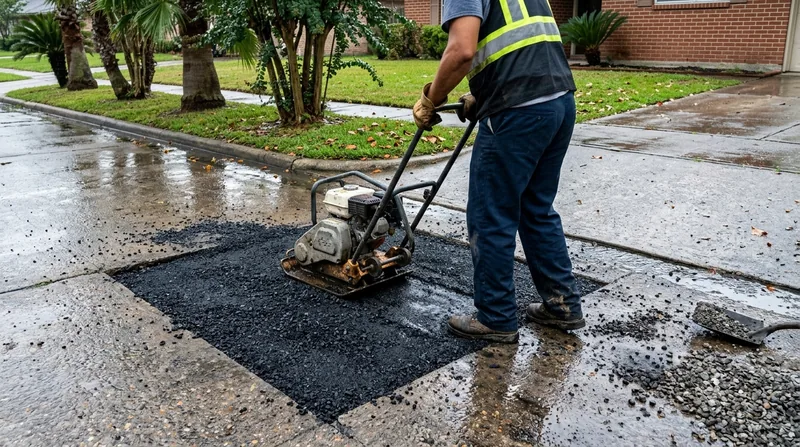




Houston's flat black gumbo clay and more than 50 inches of annual rain create ideal conditions for potholes. After tropical downpours, standing water on low-lying driveways and parking lots opens cracks that become full-depth holes within weeks. Pothole repair and asphalt patching stops that damage before it spreads across the entire surface. Whether you own a 1950s ranch in Meyerland with tree-root damage, a newer subdivision driveway in Katy or Cypress with base failure, or a commercial lot in the Medical Center or Energy Corridor, potholes demand fast action. We assess the damage on site, then choose the repair method that saves money and extends the pavement life. Most jobs book within 48 hours, and we work around Houston's summer heat and hurricane season.
Why Pothole Repair Matters in Houston: Standing Water and Subsurface Failure
Potholes form when water enters cracks, weakens the base layer, and traffic punches through the asphalt. Houston's heavy rainfall and flat terrain mean water sits on pavement longer than in sloped climates, accelerating the cycle. One pothole becomes three, then a failed section, and suddenly you need a full resurfacing or replacement instead of a patch. The earlier you fill a pothole, the lower your total cost. Parts of the east side have also subsided from historical groundwater pumping, leaving some older neighborhoods with permanent low spots where water collects and pavement fails faster.
- Potholes expand in freeze-thaw cycles, but Houston's winter cold is mild; the real driver here is water saturation and the weight of repeated traffic on a weakened base.
- Gumbo clay swells when wet and shrinks in drought, causing the subgrade to move and cracks to open, letting water in and starting the pothole cycle.
- Standing water after downpours is the visual signal that patching cannot wait; that water is already entering the base layer.
- A single pothole left unrepaired can trigger alligator cracking across a 10-foot radius within one season, especially on high-traffic areas.
- Early patching costs $450 to $800 per hole; full-section resurfacing costs $3 to $5 per square foot and takes much longer.
The key is speed. We book quick assessments so one hole does not become a failed section.
Key info: Houston's subsurface is unstable gumbo clay that moves with moisture. A pothole in Meyerland or Kingwood often signals base failure, not just a surface crack. That is why we assess the subgrade before quoting a patch; sometimes patching holds, and sometimes the money belongs in resurfacing the whole driveway.
For more detail on when patching makes sense and when you need resurfacing, see our asphalt resurfacing and overlay page.
How Pothole Repair Works: Cold-Cut Patching and Infrared Recycling
We use two proven methods, chosen based on the pothole size, the surrounding pavement condition, and how fast you need the repair. Cold-cut patching is the traditional approach for isolated holes; infrared patching recycles the asphalt in place for seamless repairs with no waiting. Both methods start with an honest assessment of the base layer. If the subgrade is sound, a patch holds for years. If the base is gone, we say so upfront.
- We measure the pothole and probe the edges to find solid asphalt, then mark a square or rectangular perimeter.
- We remove the failed section down to the base, cleaning out all debris and standing water.
- We inspect the subgrade for stability; if it is soft or wet, we dry it and compact it before filling.
- For cold-cut patching, we tack-coat the walls and floor, then fill with compacted hot-mix asphalt in layers.
- For infrared patching, we heat the surrounding asphalt and the patch material in place, blending them seamlessly with no cold seams.
- We proof-roll the repair to verify compaction and allow the surface to cool before traffic.
In most cases, the repair is ready for light traffic within hours and full traffic by the next day.
Real example: A homeowner in Sugar Land called us about a 2-foot pothole in her driveway after Harvey flooding. The base was wet but not failed. We cold-cut the hole square, dried and compacted the subgrade, filled with hot mix, and finished in one afternoon. The repair is now three years old with no movement or cracking. The money was well spent.
For complex repairs involving wider damage or multiple failures, we also offer full driveway repair services that may include grading, base stabilization, or partial resurfacing.
Pothole Repair Methods and When to Use Each
| Approach | Description | Best for |
|---|---|---|
| Cold-Cut Patching | Square out the hole, remove failed material, tack-coat, fill with compacted hot-mix asphalt in layers, finish flush. | Isolated potholes under 3 feet, stable base layer, budget-conscious repairs. |
| Infrared Patching | Heat the pothole and surrounding asphalt in place, blend new material seamlessly, no cold seams or waiting time. | High-visibility areas, driveways where you need immediate use, seamless appearance. |
| Full-Depth Replacement | Remove failed section to subgrade, rebuild base, compact, repave with new asphalt layer. | Large potholes, failed base layer, areas with repeated failure or subsurface instability. |
| Partial Resurfacing | If potholes are scattered across 25 to 40 percent of the surface, mill and overlay the whole section for durability. | Multiple failures, alligator cracking, pavement older than 15 years showing systemic wear. |
Pothole Repair and Asphalt Patching Cost in Houston: What to Expect
Pothole repair cost depends on the hole size, the subgrade condition, the access for equipment, and the method you choose. A single pothole under 3 feet runs from $450 to $800 for cold-cut patching. Infrared patching is slightly more because of equipment and fuel, but the seamless finish and immediate usability often justify it. If the pothole is larger or the base is failed, you may need full-depth replacement at $800 to $1,500 per hole. Multiple potholes across the same driveway or lot often point to a resurfacing job, which costs $3 to $5 per square foot and gives you 10 to 15 years of life instead of patching the same spots again next year.
We provide written estimates with tonnage specifications and square-footage detail, so you know exactly what you are paying for. Travel is included in our service area, which covers Houston, Sugar Land, Katy, Pearland, League City, The Woodlands, Spring, Cypress, and surrounding communities. Get 2 or 3 estimates before you decide; honest contractors will explain whether patching or resurfacing makes sense for your specific pavement. For a detailed pricing breakdown and to request a free estimate, visit our pricing page.
What to Look for When Hiring an Asphalt Paving Contractor Near Me in Houston
Paving fraud is rampant in Texas. Door-to-door crews with out-of-state plates offering "leftover asphalt from a job nearby" are the classic scam. Legitimate local contractors have a Houston address, local phone number, and a reputation in the neighborhoods where they work. Ask for references from jobs done in your area within the last two years, and call them. Verify that the contractor is fully insured with a current certificate; ask to see proof. Get written estimates that include square footage, asphalt thickness, tonnage, and the method being used. Never pay a large cash deposit upfront, and never sign a contract without a start date and a completion timeline.
For driveway work involving the apron (the section where your drive meets the street), your city or village may require a permit. Houston, Sugar Land, Katy, Pearland, and the other municipalities in our service area have different rules. A good contractor will help you navigate local permitting, not promise to "pull all permits" (which varies by jurisdiction). If your home is in a master-planned community like The Woodlands or Cypress, the HOA may have architectural standards for driveway material or width; verify those before you book. Utility locates (Texas 811) are required by law before any excavation, and a contractor who skips that step is cutting corners.
We are a local Houston paving shop in business since 2011. We work year-round in our service area and stand behind our repairs. For a free, no-obligation estimate, call us at (832) 956-1892 or request an estimate online.
Pothole Repair & Asphalt Patching in Houston: Pricing Guide
| Service | Price | Details |
|---|---|---|
| Single pothole, cold-cut patching | Starting at $450 | Includes square-cut removal, subgrade inspection, tack-coat, compacted fill, and finish. Size under 3 feet and stable base. |
| Infrared pothole patching | Starting at $650 | Seamless in-place recycling with no cold seams, ready for traffic immediately, premium finish for visible areas. |
| Full-depth pothole replacement | Starting at $800 | Complete removal to subgrade, base inspection and repair, new asphalt layer. Larger holes or failed subgrade conditions. |
| Multiple potholes or resurfacing section | On estimate | If more than three potholes or alligator cracking covers 25 to 40 percent of surface, resurfacing often costs less than repeated patches. |
| Travel and assessment | Included | No mileage fee or call-out charge in Houston and surrounding service areas including Sugar Land, Katy, The Woodlands, and others. |
| Free written estimate | No charge | Response within 24 hours at (832) 956-1892, includes tonnage and square-footage detail, no obligation to book. |
Indicative pricing, the exact cost depends on square footage, finish, and site access. Free personalized estimate within 24h at (832) 956-1892.


