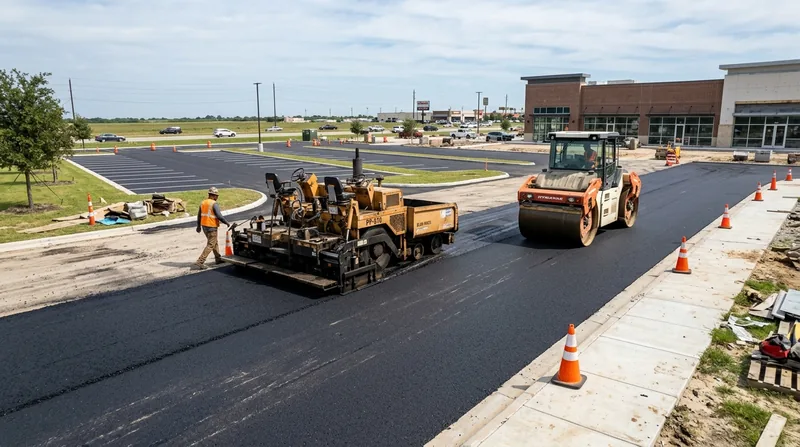




Greater Houston's commercial landscape runs from the Galleria and Energy Corridor retail strips to the Medical Center and port terminals, and every one of those properties sits on asphalt that ages fast under 95-degree summers, 50-plus inches of rain, and the relentless truck traffic of a working city. New parking lot paving and construction in Houston is not a luxury, it's a load-bearing decision that starts with honest engineering. The flat black gumbo clay that underlies the region swells and shrinks with the seasons, and tropical downpours pond on any lot without proper drainage and base prep. We build parking lots that carry the traffic they actually see, from customer vehicles to loaded dock trucks, and we phase the work around your operating hours so your business stays open while we pour.
Why Parking Lot Paving and Construction Matters in Houston's Commercial Real Estate
A parking lot is the first thing a customer or a tenant sees, and it tells a story about how the property is maintained. In Houston, the gumbo clay base heaves and settles with every wet season and drought cycle, and the summer heat oxidizes asphalt fast if the pavement is too thin or the base is not stable. A lot that fails early costs you money in repairs, liability exposure, and the loss of tenants or customers who drive somewhere else. The right thickness, the right base preparation, and the right drainage design are the difference between a lot that holds for twenty years and one that cracks and potholes after five.
- We engineer thickness to the traffic the lot will carry, from retail parking to commercial trucks at the dock.
- We stabilize the gumbo clay subgrade with lime before we lay any asphalt, so the base does not heave or settle.
- We coordinate Texas 811 utility locates on every excavation so we do not cut a water line or a power cable.
- We phase work around your hours, so tenants can park and customers can come in while we build.
- We pull tonnage specs and written estimates so you know what you are paying for and what will be installed.
A lot built right holds its surface and its value, and a lot built cheap fails on a schedule that costs more to fix than it would have cost to do it right the first time.
Key info: Houston municipal codes require a driveway apron permit where a lot meets the street, and some jurisdictions require drainage and grading permits for work that affects stormwater. Verify with your city or your HOA before we start. We help you navigate local permitting and make sure the work meets the rules that apply to your property.
For more on how parking lots and driveways work together, see our driveway extensions and aprons page.
How We Build a Parking Lot in Houston: Site Prep to Finish
A parking lot is not just asphalt poured on dirt. The soil underneath is gumbo clay that holds water and heaves in winter and spring, and if we do not prepare the base, the pavement will crack and fail. We start with a site survey and a traffic analysis, then we build the lot in layers, each one engineered for the load above it. We work around your tenants, your customers, and your operating schedule, and we keep the site safe and clean every day.
- We call Texas 811 to locate all underground utilities, so no power, water, or gas line gets cut.
- We strip the site and haul off the topsoil and any old pavement, and we grade the subgrade to the slope and elevation the drainage plan calls for.
- We proof-roll the subgrade with a heavy roller to find any soft spots, and we lime-stabilize any clay that is too wet or too weak.
- We lay the base course, usually six to eight inches of recycled asphalt millings or crushed stone, and we compact it in lifts.
- We lay the binder course, two to three inches of asphalt, and we roll it to density while it is still hot.
- We lay the wearing course, one to two inches of finished asphalt, and we roll it smooth and tight.
- We paint stripes, arrows, and any markings the lot needs, and we clean up and haul off all scrap.
The whole sequence takes planning and coordination so we do not disrupt your business. We can work early, late, or on a weekend schedule if that fits your property better.
Real example: A church in Sugar Land needed to expand its parking lot by thirty spaces to accommodate a new ministry wing. The site was mostly clay and had no formal drainage. We proof-rolled, found soft spots under the future northeast corner, lime-stabilized that zone, and built a four-inch base and a three-inch asphalt surface engineered for the light traffic of a Sunday morning lot. We worked Saturday and Sunday nights so the lot was ready for the wing's opening without disrupting services. The lot has held for three years with no cracking or settlement.
See also private road and HOA paving for work on subdivision and master-planned community streets.
Parking Lot Paving Methods and Materials
| Method | Description | Best for |
|---|---|---|
| Full-depth paving | Remove all old pavement and base, stabilize the subgrade, and build new layers from the clay up. Thickness is engineered for the traffic load. | New lots, failed lots, or lots where the old base is compromised or unstable. |
| Overlay or mill and overlay | Mill off the top one to two inches of old asphalt, and lay a new wearing course. Reuses the old base if it is sound. | Lots with good base and subgrade but worn or oxidized surface. Faster and cheaper than full-depth if the foundation is solid. |
| Patching and spot repair | Cut out failed areas, replace the asphalt, and compact. Done while the lot is in use. | Potholes, localized cracking, or damage from trucks or weather. Buys time before a full overlay or replacement. |
| Grading and drainage | Reslope the subgrade or add swales and catch basins so water does not pond on the lot. Done before new asphalt or as a standalone project. | Lots that hold water after rain, or new construction where drainage was not designed into the original site plan. |
Parking Lot Paving and Construction Cost in Houston: What to Expect
Parking lot cost depends on size, traffic load, site condition, and whether you are building new or replacing old pavement. A small retail lot of five thousand square feet on stable soil might run less than a large industrial lot with a failed base and heavy truck traffic. We give a free commercial estimate on site, and we include tonnage specs and a written breakdown so you know what you are paying for. The estimate also covers the concrete factors that move the price: base condition, clay stability, drainage work, and traffic engineering.
Houston's gumbo clay is one of the biggest cost drivers. If the subgrade is weak or wet, we lime-stabilize it before we lay asphalt, and that adds labor and material but saves the lot from heaving and cracking later. A lot with good drainage costs less to build and lasts longer than a lot where water ponds and the base stays soft. A lot engineered for heavy truck traffic needs thicker asphalt and a stronger base than a lot built for customer parking only.
Get two or three estimates. Compare not just price but also thickness, base specs, and what happens if the site inspection finds soft clay or poor drainage. The cheapest bid is often the one that skips the lime-stabilization or cuts the base course short, and that lot will fail early. A bid that includes proof-rolling, subgrade analysis, and written tonnage specs costs more upfront but holds its value and its surface.
For a full pricing overview and examples, visit our pricing page.
Parking Lot Paving and Construction Near Me: What to Look for When Hiring a Contractor
A parking lot is a major capital investment, and choosing the right contractor is as important as choosing the right design. The strongest signal of a trustworthy paving shop is that it is local, with a local address and local plates, because the historic fraud in asphalt paving is the itinerant door-to-door crew that shows up with leftover material and disappears after the check clears. A local contractor has a reputation to protect and a business address where you can find them if something goes wrong.
- Check that the contractor carries full insurance, and ask to see a certificate of insurance that lists your property as an additional insured.
- Ask for written estimates with tonnage, thickness, and base specs so you can compare apples to apples across multiple bids.
- Ask for references from commercial properties, not just residential driveways, and call at least two and ask how the lot has held up.
- Verify that the contractor will call Texas 811 for utility locates and will pull any permits your city or your HOA requires.
- Ask about the contractor's experience with gumbo clay and Houston's weather, and whether they lime-stabilize the subgrade as standard practice.
- Do not hire on the spot. Take the estimate home, compare it to others, and call back with questions before you commit.
A contractor who gives you time to decide, answers technical questions, and puts everything in writing is the one who will deliver a lot that holds its value and its surface.
Ready to get started? Contact us for a free commercial estimate, or call (832) 956-1892.
Parking Lot Paving & Construction in Houston: Pricing Guide
| Service | Price | Details |
|---|---|---|
| Free commercial estimate | Free | On-site survey, traffic analysis, soil and drainage assessment, written tonnage and thickness specs |
| Small retail lot (up to 10,000 sq ft) | Starting at $15,000 | Full-depth paving with lime-stabilized base, four-inch base course, three-inch asphalt, on stable clay |
| Medium commercial lot (10,000 to 25,000 sq ft) | Starting at $35,000 | Full-depth paving, gumbo clay stabilization, drainage work, four-inch base, three-inch wearing course |
| Large industrial or expanded lot (25,000+ sq ft, truck traffic) | On estimate | Site-specific engineering, heavy-duty base, drainage design, phased construction around operations |
| Overlay or mill and replace | Starting at $8,000 | Milling old surface, new two-inch wearing course, reuses sound base, faster than full-depth replacement |
| Travel and coordination | Included | No mileage fee in Houston and surrounding areas, Texas 811 utility locates included in all excavation work |
Indicative pricing, the exact cost depends on square footage, finish, and site access. Free personalized estimate within 24h at (832) 956-1892.


