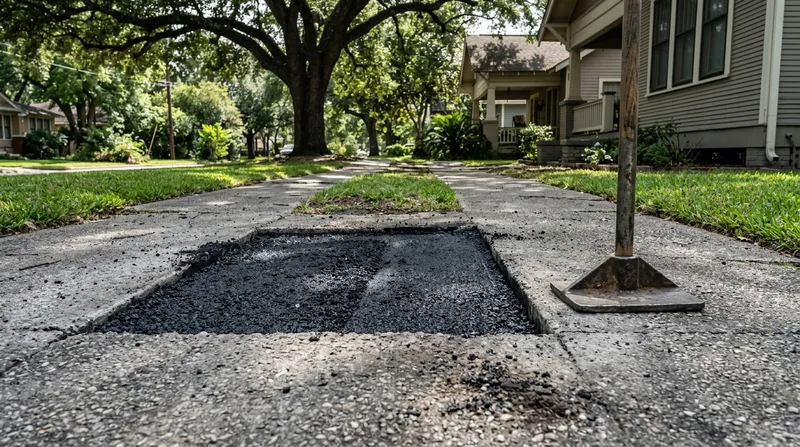




Driveway Repair in Houston means fixing the cracks, heaves, and sunken edges that Houston's gumbo clay and live oak roots inflict on asphalt year after year. The flat black soil swells when rain arrives in tropical downpours and shrinks in summer heat, pushing up sections and opening seams. Tree roots, especially from the massive live oaks that shade the older neighborhoods of the Heights, Montrose, River Oaks, and the 1950s ranches of Meyerland and Spring Branch, crack asphalt from below. The apron where your driveway meets the street settles unevenly because the subgrade was never lime-stabilized before the original pour. We repair these failures with full-depth patches that key into sound asphalt instead of skin patches that fail by the next storm season, and we tell you honestly when a repair buys you years and when the money belongs in asphalt resurfacing instead. We have been doing this since 2011, and we are fully insured.
Why Driveway Repair Matters in Houston's Climate and Soil
Houston sits on black gumbo clay that expands and contracts with the wet and dry seasons, lifting asphalt unevenly and opening cracks that admit water. More than 50 inches of rain arrive in intense storms that pond on flat lots, and events like Hurricane Harvey undercut whole neighborhoods and destabilize driveways for years afterward. The summer heat above 95 degrees softens and oxidizes asphalt, making it brittle by fall. Live oaks and crepe myrtles, which dominate the older residential stock from the Museum District to Sharpstown, send roots horizontally under shallow driveways and heave sections upward. Pothole formation accelerates in spring when freeze-thaw cycles (rare but real in January) combine with standing water. Without repair, a cracked driveway admits water to the base layer, and within two to three years the failure spreads and the entire surface becomes unstable.
- Gumbo clay expansion in wet months pushes up sections and opens transverse cracks that widen with each rainfall.
- Live oak roots grow horizontally under driveways and lift asphalt in arcs, especially in neighborhoods like Meyerland, Bellaire, and the Heights.
- Water entering cracks penetrates the base and subgrade, weakening the foundation and triggering alligator cracking within 18 to 36 months.
- Summer heat and UV oxidation make asphalt brittle, so cracks opened by heave do not seal themselves and grow wider each season.
- Spring is the critical repair window because winter moisture has saturated the subgrade and summer heat is coming, making failure imminent.
Addressing a cracked driveway in spring before the summer heat and the next rainy season prevents the base from failing and saves you from a full replacement in five years.
Key info: Houston's municipal codes vary by village. The apron where your driveway meets the street is often regulated by the city or HOA. We help you navigate local permitting requirements. Verify requirements with your local building department or HOA before work begins. See the City of Houston Public Works website for right-of-way rules.
How We Repair Driveways: Full-Depth Patching and Honest Assessment
We start with a site visit to measure the failed area, probe the edges to find where sound asphalt begins, and determine whether the base is still intact or whether the failure runs deep. If the patch is less than 20 to 25 percent of the driveway surface and the surrounding asphalt is sound, a full-depth patch is the right call. If the damage is scattered across 30 to 40 percent or more, or if alligator cracking dominates, we recommend asphalt resurfacing or overlay because patching throws money away. We remove the failed section to the base, clean and tack the edges, and pour new asphalt that bonds to the existing pavement. The new patch is compacted to match the surrounding surface and is ready for light traffic the next day, though full cure takes several months.
- We measure the failed area and probe the edges to determine the depth and extent of damage below the surface.
- We remove failed asphalt to the base layer and inspect the subgrade for water, settlement, or soft spots.
- We clean the patch edges, apply a tack coat, and pour new asphalt mixed to match the surrounding pavement.
- We compact the patch to the proper density and finish it flush with the existing surface.
- We advise you on whether the repair will hold for 5 to 10 years or whether the driveway needs resurfacing within the next two to three years.
This approach is honest because we tell you upfront whether you are buying years or whether you are delaying the inevitable replacement.
Local example: A 1950s ranch in Meyerland with a 30-by-18-foot driveway has two heaved sections along the center line caused by a live oak root. The rest of the asphalt is intact. A full-depth patch of each heaved area costs less than a third of a resurface and extends the life of the driveway by 7 to 10 years. In contrast, a 40-by-20-foot driveway in Sugar Land with alligator cracking across 50 percent of the surface means the base is failing and a patch will fail within 18 months. That driveway needs a resurface or replacement.
Driveway Repair Methods and When to Use Each
| Approach | Description | Best for |
|---|---|---|
| Full-Depth Patch | Remove failed asphalt to the base, inspect the subgrade, clean edges, apply tack, and pour new asphalt compacted to density. | Single heaved or cracked sections, sunken aprons, localized failures covering less than 25 percent of the driveway surface. |
| Partial Patch (Spot Repair) | Remove and replace a smaller failed area, useful for isolated potholes or edge crumbling on driveways with otherwise sound asphalt. | Pothole repair, crumbled edges, single cracks wider than one-quarter inch, temporary relief while planning a resurface. |
| Asphalt Overlay | Mill or grind the top one to two inches of failed asphalt and pour a new wearing course, bonding to the existing base. | Widespread cracking across 25 to 40 percent of the surface, oxidized asphalt losing grip, multiple patches needed, base still sound. |
| Full Removal and Replacement | Remove all asphalt, inspect and lime-stabilize the subgrade, pour new base and wearing course, recommended for severe heave or failed base. | Alligator cracking across more than 40 percent, sunken sections caused by subgrade failure, tree root heave requiring grading, apron settlement. |
The choice between these methods depends on the extent and depth of the failure, the condition of the base, and your budget and timeline. A site visit and written estimate clarify which approach makes sense for your driveway.
Driveway Repair Cost in Houston: What to Expect
Driveway repair pricing in Houston starts at around $450 for a small pothole or edge repair and rises with the size and depth of the failed area. A full-depth patch of a heaved or cracked section 15 to 20 feet long and 3 to 4 feet wide typically runs $800 to $1,500, depending on access, base condition, and whether the subgrade needs reworking. Multiple patches on the same driveway cost less per patch because we are already on site and set up. An overlay of a 30-by-18-foot driveway with moderate cracking runs $1,200 to $2,000. Full replacement of a residential driveway in that size range, including subgrade lime stabilization and proper base, runs $2,500 to $4,500 or more if grading or tree root removal is required.
Factors that move the price up include: tree roots that have to be cut or the subgrade reworked; soft or wet subgrade that requires lime stabilization or proof rolling; access constraints such as a narrow gate or steep slope; and whether the apron (where the driveway meets the street) must be cut and reset, which involves permitting and potentially utility locates under Texas 811 law. We provide a written estimate that includes the square footage, the depth and method, the tonnage of asphalt, and a timeline. See our full pricing overview for typical ranges, and call us at (832) 956-1892 for a free estimate on your specific driveway.
Driveway Repair Near Me: What Houston Homeowners Should Know When Hiring
The strongest trust signal in driveway paving is being verifiably local. The historic fraud in this trade is the itinerant door-to-door crew with out-of-state plates offering to use "leftover asphalt from a job nearby" at a cash price with no contract. We are based in Houston, carry full insurance, and provide written estimates with tonnage and thickness specifications. When you call, ask any contractor for proof of insurance, a written contract before work begins, and a breakdown of what is included at the quoted price. If you live in a master-planned community like Katy, The Woodlands, Pearland, or Cypress, check your HOA architectural guidelines because some require approval for driveway work or restrict materials. If your driveway apron extends into the street right-of-way, your city or village may require a permit. We help you navigate these requirements, but you should verify them with your local building department or HOA before we begin.
- Verify that any contractor you hire carries current liability and property damage insurance and can provide a certificate on request.
- Get written estimates from at least two or three contractors, with square footage, depth, tonnage, and timeline clearly stated.
- Ask for references from recent jobs in your area, and call them to confirm the work quality and that the job was completed on time and on budget.
- Confirm whether your driveway apron requires a municipal permit by contacting your local building department or HOA before you book the work.
- Require a signed contract before any work begins, and never pay a large cash deposit upfront or in full before the job is complete.
- Avoid contractors who quote a price per square foot without a site visit, or who promise a lifetime warranty on asphalt, which is not possible.
Contact us for a free, no-obligation estimate. We respond within 24 hours and can often schedule a repair within one to two weeks depending on weather and our schedule.
Driveway Repair in Houston: Pricing Guide
| Service | Price | Details |
|---|---|---|
| Pothole or small edge repair | Starting at $450 | Single pothole, crumbled edge, or small crack up to 50 square feet, includes removal, base inspection, and new asphalt |
| Full-depth patch (heaved or cracked section) | Starting at $800 | Patch 15 to 20 feet long and 3 to 4 feet wide, includes base inspection and subgrade assessment; tree root cutting costs extra |
| Multiple patches or apron repair | Starting at $1,200 | Two or more patches on same driveway, or sunken apron section; cost per patch decreases when work is contiguous |
| Driveway overlay or resurface | Starting at $1,500 | Typical 30-by-18-foot driveway with moderate cracking; cost depends on current surface condition and base soundness |
| Full driveway replacement | On estimate | Complete removal, subgrade lime stabilization, new base and asphalt; tree root removal, grading, or apron permitting increase cost significantly |
| Estimate and site visit | Free | We provide written estimates with tonnage, thickness, and timeline; response within 24 hours at (832) 956-1892 |
Indicative pricing, the exact cost depends on square footage, finish, and site access. Free personalized estimate within 24h at (832) 956-1892.


