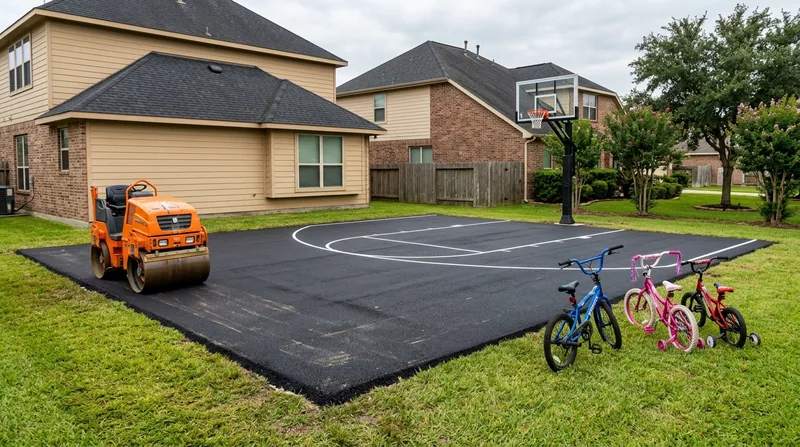




Houston's master-planned suburbs, estates and ranchettes demand hard, true playing surfaces that hold their lines through gumbo-clay movement and summer heat. A sports court and path paving job in the greater Houston area is not a standard driveway: it requires dead-flat tolerance, engineered base structure, and acrylic-ready surface finish that stays stable when the clay below swells in tropical downpours and shrinks in drought. Whether you are installing a backyard basketball court in Cypress or a pickleball base in Sugar Land or a walking path through an HOA common area in The Woodlands, the asphalt must be built to tighter specs than residential parking. We build the structural layers and finish the surface so your court stays true, and we understand the Houston subgrade, lime-stabilized clay, proof-rolled base, and a wearing course laid flat to within a quarter-inch across the entire slab.
Why Sports Court and Path Paving Matters in Houston's Residential and HOA Communities
Houston's recreational surfaces age differently than asphalt driveways. A basketball court or tennis base carries dynamic loads, hard impacts, and directional stress that demand both structural integrity and surface precision. The gumbo clay that underlies most of the Houston area swells to 8 to 10 percent when saturated in tropical rains and contracts sharply in drought, creating differential settlement that cracks ordinary asphalt. A court built on an uncontrolled or undersized base will develop edge cracking, settlement pockets, and alligator cracking within two to three seasons. HOA architectural standards and deed restrictions often govern court materials and placement, and some municipalities require permits for recreational structures or impervious surface additions. The investment in a properly engineered court pays off in years of level, playable surface and protection against the Houston climate.
- We size and stabilize the subgrade with lime treatment and proof rolling to prevent settlement under the clay swelling and shrinking cycle.
- We build a structural base course with the correct thickness and compaction to handle repeated impact loads without deflection.
- We finish the wearing course dead-flat within tight tolerance so acrylic color systems and line paint sit true and do not pond or channel water.
- We verify local HOA rules and municipal permits before breaking ground, so your court meets all deed restrictions and right-of-way requirements.
- We design drainage so water sheds off the surface and does not pool at the edges or undermine the base during Houston's 50-plus inches of annual rain.
A properly built court is an asset that lasts years; a poorly built one becomes a liability within a single season.
Key info: Houston's master-planned HOA communities like The Woodlands, Sugar Land and Pearland often require architectural approval and deed compliance for recreational structures. Verify your HOA rules before committing to a court design or location. Many villages also require a permit for work that adds impervious surface or affects drainage. We help you navigate the local process, and you can confirm requirements with your HOA board and municipal building department.
For detailed guidance on permitting and contractor selection, review your city's building department website or contact the Houston Planning and Development Department for unincorporated Harris County work.
How We Build Sports Courts and Paths in Houston: Process and Precision
Building a court or path in Houston starts with understanding the ground. The subgrade preparation is half the job: we excavate to proper depth, test the clay, apply lime stabilization if needed, and proof-roll the base to ensure it will not settle under load or water infiltration. Then we layer the structural base with the correct aggregate and compaction, set drainage, and finish with a tight-tolerance wearing course ready for paint and acrylic. The entire sequence is driven by Houston's clay, the tropical rain cycle, and the thermal stress of summer heat above 95 degrees.
- We survey the site and excavate to the depth required by court type, slope, and local soil conditions.
- We test the subgrade clay and apply lime stabilization to prevent swelling and differential settlement.
- We place, compact, and proof-roll the base course to the density and thickness specified for the expected load.
- We set drainage swales or underdrain systems so water does not pond on or beneath the court during heavy rain.
- We lay the wearing course asphalt in a single or two-lift sequence, finishing dead-flat to within a quarter-inch tolerance.
- We verify the finish surface with straightedge and laser level before the court is released for acrylic, paint, or line marking.
This methodical approach means your court will not crack, settle, or channel water when the Houston clay moves and the summer sun bears down.
Local example: A half-court installation in a Bellaire residential lot required removal of a failed gravel pad, lime stabilization of the underlying clay, a 6-inch compacted base, and a 2-inch wearing course finished to within 1/8-inch flatness. The court was painted and lined within 48 hours and has remained level and crack-free through three seasons of summer heat and tropical downpours. Proper subgrade work made the difference.
For similar precision work on your property, learn more about our gravel driveway installation and grading services, which apply the same base-preparation discipline to rural and residential sites across the Houston area.
Sports Court and Path Paving Methods: Choosing the Right Approach for Houston
| Court Type | Description | Best for |
|---|---|---|
| Full Basketball or Tennis Court | Complete excavation, lime-stabilized subgrade, compacted base course, and finished wearing surface with tight flatness tolerance for acrylic and line paint. | New construction on residential or HOA property where the ground is clay or poorly drained. |
| Pickleball or Multi-Sport Pad | Smaller footprint with the same structural discipline: stabilized subgrade, proper base, and finish-flat wearing course. | Compact residential yards or HOA common areas where space is limited but performance must be high. |
| Walking Path or Golf Cart Trail | Reduced structural depth but same drainage and finish discipline; path is crowned and sloped to shed water, surface is smooth and stable. | Pedestrian access, cart circulation, or accessible routes through residential or HOA grounds. |
| Resurfacing or Overlay on Existing Court | Existing base is sound; we remove surface, verify subgrade, mill and replace the wearing course, and re-finish to tight tolerance. | Courts 8 to 12 years old where the base is still solid but the surface is oxidized, cracked, or uneven. |
Each approach is sized to the Houston climate and subgrade, with drainage designed for tropical downpours and base compaction sized for the clay movement cycle.
Sports Court and Path Paving Cost in Houston: What to Expect
A new sports court and path paving installation in the Houston area starts at approximately $8,500 for a small pickleball court or walking path on a well-prepared site. A full-size basketball or tennis court typically runs $12,000 to $18,000 depending on excavation depth, subgrade treatment, base structure, and finish specifications. The single largest cost driver is subgrade preparation: if the clay is unstable or poorly drained, lime stabilization and thickened base course add significantly to the price. Access (tight residential lot versus open property), drainage requirements (swales, underdrains, or grading), and the extent of excavation and removal all affect the final number. A court built in a master-planned HOA may also carry design review fees or architectural approval costs that are outside the paving scope.
The best way to understand your project cost is to request a free, no-obligation estimate from our team. We visit the site, assess the subgrade, measure the court footprint, review any HOA or municipal requirements, and provide a written estimate with tonnage and material specs. Most estimates are ready within 24 hours. Call us at (832) 956-1892 or visit our contact page to request an estimate.
We recommend getting 2 to 3 estimates from different contractors so you can compare scope, base thickness, and finish quality. A low estimate that cuts subgrade preparation or uses thin base course will fail within a few seasons in the Houston clay cycle; a realistic estimate reflects the true cost of proper work.
For more detailed pricing information and examples across all our services, visit our full pricing overview.
What to Look for When Hiring a Sports Court Paving Contractor Near Houston
Hiring a paving contractor for a court or path is a bigger decision than hiring for a driveway repair, because the cost is higher, the precision requirements are tighter, and the failure modes are more visible. A contractor who cuts corners on subgrade or base preparation will deliver a court that cracks, settles, and becomes unplayable within a season or two. Here is what to verify before you sign a contract.
- Ask the contractor to provide a detailed site visit, written estimate, and material specifications including base thickness, asphalt tonnage, and compaction requirements.
- Verify that the contractor understands Houston subgrade conditions and can explain how they will handle lime stabilization, proof rolling, and drainage for your specific site.
- Request references from at least two or three similar court or path projects completed in the Houston area within the past three years.
- Confirm that the contractor carries full general liability insurance and can provide a certificate of insurance before work begins.
- Verify with your HOA or municipal building department whether permits are required for the court, surface addition, or drainage work, and confirm the contractor understands the local approval process.
- Get the estimate in writing with a clear scope of work, timeline, and payment schedule; avoid cash-only deals or large upfront deposits before work starts.
A contractor who is local, familiar with Houston clay and drainage, willing to explain their subgrade approach, and able to provide recent references is far more likely to deliver a court that lasts.
Ready to get started? Contact us today for a free estimate and site assessment. We have served the Houston area since 2011 and understand the subgrade and climate challenges that every court in this region faces.
Sports Court & Path Paving in Houston: Pricing Guide
| Service | Price | Details |
|---|---|---|
| Pickleball Court or Small Path | Starting at $8,500 | Includes excavation, subgrade stabilization, compacted base, and finished wearing course ready for acrylic paint and lines |
| Full Basketball or Tennis Court | Starting at $12,000 | Complete installation with lime-stabilized subgrade, structural base, drainage, and tight-tolerance finish surface on residential property |
| Walking Path or Golf Cart Trail | Starting at $6,500 | Reduced structural depth with proper drainage and smooth finish for pedestrian or cart access through residential or HOA grounds |
| Resurfacing Existing Court | Starting at $4,500 | Removal and replacement of wearing surface when base is sound; includes verification of subgrade and finish-flat installation |
| Complex or Large Project | On estimate | Multi-court installations, extensive drainage work, or difficult subgrade require site assessment and detailed engineering before pricing |
| Free Estimate | No obligation | Site visit, written scope, and material specifications provided within 24 hours; call (832) 956-1892 to schedule |
Indicative pricing, the exact cost depends on square footage, finish, and site access. Free personalized estimate within 24h at (832) 956-1892.


