



Houston's commercial parking lots and private pavement face a brutal triple threat: parking lot repair and resurfacing demands spike each spring as the winter rain cycle exposes potholes and alligator cracking, summer heat above 95 degrees softens and oxidizes asphalt fast, and the black gumbo clay subgrade swells in wet months and shrinks in drought, fracturing the base beneath. From the Galleria and Energy Corridor retail strips to the ship channel warehouses and northwest distribution hubs, property managers watch their lots deteriorate from standing water, heavy traffic, and the relentless Texas sun. We work fast to get the liability off your lot, moving from inspection through patching to full overlays without the downtime that kills tenant confidence. Annual maintenance programs bundle regular inspections with strategic patching and drainage checks so ponding and small failures never become tenant complaints or insurance claims. Call us at (832) 956-1892 for a free written estimate, or read on to understand what parking lot repair and resurfacing really costs and how to choose the right contractor.
Why Parking Lot Repair and Resurfacing Matters in Houston Commercial Real Estate
A failed parking lot is a liability magnet. Potholes collect standing water that breeds mosquitoes and algae, crack tires and suspension systems, and expose your property to slip-and-fall claims. Alligator cracking across thirty to forty percent of the surface signals that the base has failed, and ignoring it means the problem spreads, the lot becomes unsafe, and a full replacement becomes the only fix. In Houston, where tropical downpours and bayou floods hit hard and often, drainage is the first failure point: water that ponds on flat pavement finds cracks, seeps into the base, and turns subgrade clay into mud. Resurfacing or full-depth repair stops that cycle before it reaches the base, and maintenance programs catch small failures before they grow into expensive emergencies.
- Potholes and failed sections create tenant complaints and liability exposure that escalates fast.
- Standing water and poor drainage accelerate base failure and shorten pavement life.
- Regular inspection and patching catch damage early, keeping repair costs predictable and low.
- Storm inlet rebuilds and full overlays restore function and safety without closing the lot for weeks.
- Sweeping and seasonal maintenance remove debris and standing water that trap moisture and cause cracking.
Property managers in Katy, Sugar Land, and League City who schedule annual maintenance programs find that their lots hold together through the summer heat and hurricane season, and their tenants stay happy.
Key info: Houston's building code and stormwater rules are set by the municipality and vary across the city and surrounding villages. The City of Houston requires that parking lots meet drainage standards and that curb cuts and impervious-surface limits comply with local regulations. Verify your lot's requirements with your city or village building department before you plan any resurfacing or expansion work. The Houston Public Works Department administers these rules for the city proper, and each suburb enforces its own standards.
For more on how to choose a contractor and navigate the permitting landscape, see our guide to asphalt repair in Houston.
How We Handle Parking Lot Repair and Resurfacing in Houston
We start with a walk-through inspection that measures failed sections, checks drainage, and identifies any base failure or structural damage. We photograph the lot, note the thickness of existing pavement, and sketch a plan that addresses the worst failures first. From there, we offer you a choice: spot patching for isolated potholes and cracks, full-depth repairs for sections where the base is compromised, or a complete overlay if the surface is too far gone but the base is still sound. For commercial lots with heavy traffic or strict uptime requirements, we stage the work in phases so the lot stays open during business hours.
- We inspect the entire lot, measure failed areas, and identify drainage problems before we write an estimate.
- We pull a core sample to check pavement thickness and base condition if the damage pattern suggests base failure.
- We offer written estimates that state the tonnage of new asphalt, the depth of the overlay or repair, and the timeline for each phase.
- We coordinate with your tenants and property manager to schedule work during off-peak hours or weekends if the lot must stay open.
- We haul and sweep the lot after the work is done so your pavement looks finished and professional.
A typical parking lot resurfacing in Houston takes two to four days for a small retail strip and one to two weeks for a large warehouse or HOA road, depending on the size, the weather, and whether we are doing full-depth repairs or just an overlay.
Example: A ten-thousand-square-foot parking lot at a shopping center in Pasadena had standing water in the southwest corner and alligator cracking across the north side. We inspected it, found that the base was still intact but the surface was oxidized and broken, and recommended a one-and-a-half-inch overlay. We scheduled the work for a Saturday and Sunday when the center was closed, removed the old surface layer, milled it for recycling, laid new asphalt, and swept the lot clean. The owner reopened Monday morning with no downtime.
For details on our other repair and resurfacing services, visit our page on asphalt resurfacing and overlay in Houston.
| Approach | Description | Best for |
|---|---|---|
| Pothole and crack patching | We clean out the failed section, tack the edges, and fill with hot-mix asphalt compacted to density. | Isolated failures, less than five percent of the lot surface, and good underlying base. |
| Full-depth patching | We remove the entire failed section down to the subgrade, rebuild the base with stone or recycled asphalt, and overlay new pavement. | Potholes that are deep, areas where the base has failed, and sections with standing water or poor drainage. |
| Overlay or resurfacing | We mill the top layer of old asphalt, recycle it, and lay a new wearing surface one and a half to two inches thick. | Oxidized, cracked, or rutted pavement where the base is still sound and alligator cracking covers less than thirty percent. |
| Full replacement | We mill and remove all existing asphalt, rebuild the base with proper stone and grading, and install new pavement to specification thickness. | Alligator cracking across more than forty percent of the lot, base failure, or extensive subsurface damage from water or tree roots. |
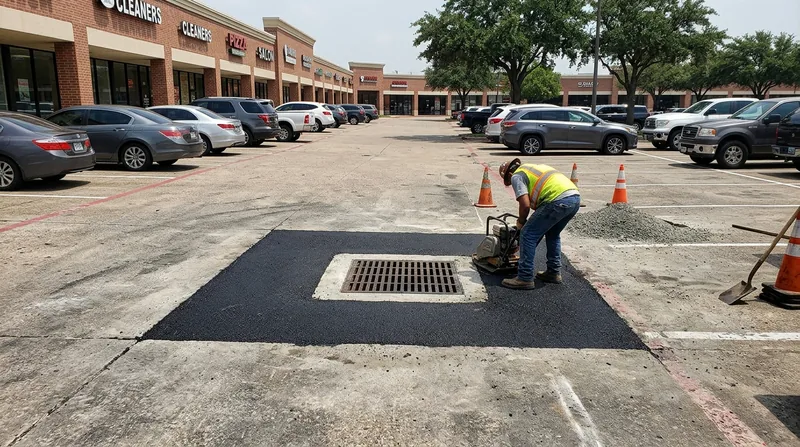
| Storm inlet and drainage repair | We rebuild sunken storm drains, regrade the pavement around them, and repair or replace the grates and sumps so water flows away from the lot. | Standing water, ponding around inlets, or failed drainage that accelerates cracking and base erosion. |
Parking Lot Repair and Resurfacing Cost in Houston: What to Expect
Parking lot repair and resurfacing costs depend on the size of the lot, the extent of the damage, whether you need base repair or just a surface overlay, and the cost of materials and labor in your area. Spot patching for a few potholes starts around $650 and goes up with the number of holes and the depth of the repairs. A full-depth repair that includes base work runs higher because we have to remove the failed section, rebuild the subgrade, and compact new stone before we lay asphalt. An overlay across the entire lot typically costs more than patching but less than full replacement, and it is the right choice when the base is sound but the surface is oxidized or cracked.
The best way to know what your lot will cost is to get a free written estimate from us. We measure the lot, inspect the damage, and give you a breakdown that shows the square footage, the tonnage of asphalt, the depth of the work, and the total price. We also list travel as a separate line so you see what you are paying for. For a detailed pricing overview and a breakdown by service type, visit our full pricing page.
Factors that move the price up include the size and complexity of the lot, whether the base needs repair or just the surface, how much of the lot is failing, the cost of hauling away old asphalt, whether we need to rebuild storm drains or regrade for drainage, and the season (summer heat and hurricane season can affect scheduling and material costs). Lots with heavy tree cover or tight access may cost more because we have to work around the obstacles or bring in smaller equipment.
Real example: A five-thousand-square-foot retail parking lot in Sugar Land with scattered potholes and alligator cracking across twenty percent of the surface was quoted at around $4,500 for a one-and-a-half-inch overlay with spot repairs to the worst sections. A fifteen-thousand-square-foot warehouse lot in Katy with base failure in two areas and poor drainage was quoted at $18,000 for full-depth repairs in the failed zones plus a one-inch overlay across the rest. The difference is the amount of base work and the tonnage of new asphalt.
We recommend getting two or three estimates from different contractors so you can compare the scope, the thickness, and the tonnage. A good estimate will tell you exactly what you are paying for, not just a price per square foot. Call us at (832) 956-1892 for your free estimate, or contact us online and we will respond within 24 hours.
Parking Lot Repair and Resurfacing Near Me: What Houston Property Managers Should Know When Hiring a Contractor
Choosing the right asphalt contractor is the single most important decision you make for your lot. The historic fraud in paving is the unsolicited door-to-door pitch: "we have leftover asphalt from a job nearby and can give you a deal." That contractor has no local address, no local phone number, a cash deposit up front, and a price that is too good. When the work is done, you have no recourse. A real contractor is local, has a verifiable address and phone number, provides a written contract and estimate before any work starts, and carries insurance that protects you if something goes wrong.
- Verify that any contractor you hire is fully insured and can provide a current certificate of insurance before work begins.
- Ask for written estimates that include the square footage, the thickness of the asphalt, the tonnage, and the total price with no surprises.
- Check references from other property managers or commercial customers in your area, and ask them about the quality of the work and whether the contractor finished on time.
- Confirm that the contractor understands the permitting requirements for your city or village, because parking lot work often requires a right-of-way permit or a curb cut approval.
- If your lot is in an HOA community, verify that the contractor is willing to work within any architectural standards or material requirements that your HOA imposes.
- Ask about the contractor's experience with drainage and storm inlet work, because standing water is the fastest path to pavement failure in Houston.
We have been in business since 2011, we are local to Houston, and we provide free written estimates with tonnage and thickness specs so you know exactly what you are paying for. We carry full insurance, we coordinate with your city or village on any required permits, and we work with HOA requirements and architectural standards. Call us at (832) 956-1892 or request a free estimate online today.
Parking Lot Repair & Resurfacing in Houston: Pricing Guide
| Service | Price | Details |
|---|---|---|
| Pothole and crack patching | Starting at $650 | Isolated failures, material and labor included, price increases with number of potholes and repair depth |
| Full-depth repair with base work | Starting at $1,200 | Failed sections removed to subgrade, base rebuilt with stone, new asphalt installed, price depends on area size |
| Overlay or resurfacing | Starting at $3,500 | One and a half to two inch overlay across entire lot, milling and recycling included, cost scales with lot size |
| Full replacement | On estimate | Complete removal, base rebuild, new installation, requires site inspection to measure damage and determine tonnage |
| Storm inlet and drainage repair | Starting at $800 | Inlet rebuild, grate and sump replacement, regrade for proper water flow, cost varies with number of inlets |
| Free estimate | No obligation | Written estimate within 24 hours, includes tonnage and thickness specs, call (832) 956-1892 or contact online |
Indicative pricing, the exact cost depends on square footage, finish, and site access. Free personalized estimate within 24h at (832) 956-1892.


