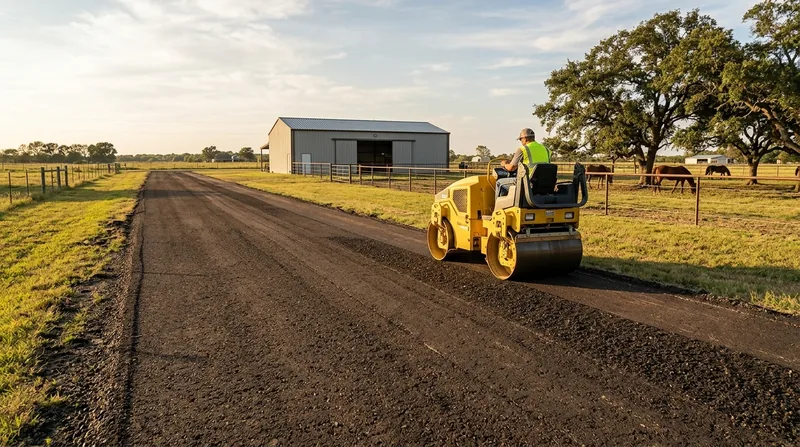




Recycled asphalt and millings driveways in Houston offer a solid, budget-conscious surface for long ranch drives, equipment pads, and rural access roads across the flat black gumbo clay terrain of Greater Houston and the surrounding counties. Unlike loose gravel that washboards under summer heat and heavy rain, compacted millings bind together and shed water when graded correctly, holding up to the intense Texas sun and the 50-plus inches of annual rainfall that pound the upper Gulf Coast. For property owners in areas like Acres Homes, Magnolia, Waller, and the ranchette properties north toward Conroe and west toward Fulshear, recycled millings deliver a step up from gravel at a fraction of the cost of hot mix asphalt. We grade the subgrade, spread and roll the millings to proper crown and compaction, and tell you plainly where hot mix pays for itself and where millings will serve you well for years. Call (832) 956-1892 for a free written estimate with tonnage and thickness specs.
Why Recycled Asphalt and Millings Matter on Houston's Flat, Wet Terrain
Houston's landscape sits on flat gumbo clay that swells in wet months and shrinks and cracks in drought, a subgrade that demands proper grading and drainage before any surface goes down. Recycled asphalt millings, also called reclaimed asphalt pavement or RAP, are compacted fragments of broken-down asphalt that re-bind under the weight of traffic and the intense summer heat above 95 degrees. On a long ranch drive or a private road where full hot mix asphalt costs thousands per ton, millings give you a dark, stable surface that hardens over time and resists the ponding water that pooled during Hurricane Harvey and floods that still threaten low-lying neighborhoods. The material is environmentally sensible, locally sourced from milling operations and old parking lot removals, and it costs roughly one-third to one-half what new hot mix does.
- Recycled millings bind tighter than gravel under Houston heat and compress into a load-bearing surface that sheds water when crowned correctly.
- The cost per ton runs 40 to 60 percent below new hot mix asphalt, making long drives and equipment pads affordable on ranch and rural properties.
- Proper grading and base prep prevent the standing water that wrecks drives in the heavy rain season and tropical downpours common to the Gulf Coast.
- The material hardens further each summer, requiring minimal maintenance if drainage is right and traffic is steady.
- Recycled asphalt is a real product with real tonnage and thickness specs, not a shortcut, and we give you written estimates naming the exact tons and depth we will lay.
These factors make recycled millings the right choice for ranch roads, long rural drives, and equipment pads where a full asphalt driveway is either unnecessary or a future upgrade once the property is settled.
Key info: In Waller County, Fort Bend County, and the unincorporated areas north of Houston toward Conroe, many ranch and acreage properties have no municipal permitting requirement for a private drive. We verify local rules before we start. In master-planned subdivisions like The Woodlands, Pearland, and Sugar Land, HOA architectural standards may restrict driveway materials, so we confirm approval with the HOA before recommending millings as a surface. Always check your local building department and HOA rules before you commit.
For more on how recycled materials fit into your paving strategy, see our guide to asphalt milling and removal.
How We Grade, Spread, and Roll Recycled Millings on Your Houston Drive
Recycled asphalt millings are only as good as the base and the crown underneath them. On Houston's gumbo clay and the subsided areas of the east side, we start by grading the subgrade to remove soft spots, standing water, and root intrusion from live oaks and crepe myrtles that crack older ranch house driveways. We then spread the millings to a measured thickness, typically 2 to 3 inches of compacted depth, and roll them with a vibratory compactor to knit the fragments together. The crown must shed water to the sides, not pond in the middle, so we slope the drive 2 to 4 percent depending on the width and the local drainage. After rolling, the millings are firm but not yet fully hardened. Traffic and summer heat do the rest over the first few weeks.
- We measure the site, calculate the tonnage needed, and give you a written estimate with depth and compaction specs before we bring material to your property.
- We grade and slope the subgrade to prevent the ponding water that causes washouts and subsidence on flat Houston lots.
- We spread the recycled asphalt millings evenly and roll them with a compactor to achieve the density that lets the fragments bind together under traffic.
- We confirm proper drainage and crown so water sheds to the roadside and does not pool in the middle of the drive.
- We explain the curing timeline: the surface hardens further over the first 4 to 6 weeks as traffic and heat work the fragments together.
The whole process takes one to two days for a typical long ranch drive, depending on the length and the condition of the existing subgrade.
Example: A 400-foot ranch drive in Magnolia with standing water in the middle and ruts from tractor traffic required full grading to remove soft clay, then a 2.5-inch lift of recycled millings rolled to 95 percent density. The cost was roughly $800 to $1,200 for material and labor, versus $3,500 to $4,500 for new hot mix. After two summers of use, the surface is firm and dark, shedding rain properly, and will serve for another five to seven years before a top-up is needed.
If your drive is older and showing cracks or soft spots, our driveway repair service can patch problem areas before a millings overlay, or we can recommend full replacement if the base is truly gone.
Recycled Asphalt and Millings: Methods and When Each Works
| Approach | Description | Best for |
|---|---|---|
| Fresh Millings on Prepared Grade | We grade the subgrade, remove soft clay and water, then spread and roll 2 to 3 inches of recycled asphalt millings to proper crown and density. | New ranch drives, equipment pads, and long rural access roads where the subgrade is sound or needs light grading. |
| Millings Over Existing Gravel | We scarify or blend the existing gravel base, add recycled millings, and roll the combined layer to bind it together. | Older gravel drives that are washboarded or rutted but have a solid subgrade underneath. |
| Millings as a Top-Up or Maintenance Layer | After 5 to 7 years, a millings drive will compress and thin slightly. We add a fresh 1 to 1.5 inch layer, re-roll, and extend the life another 5 to 7 years. | Maintaining an established millings drive without full replacement. |
| Millings Under Hot Mix Overlay | We lay recycled millings as a base course, roll and cure them for a week, then overlay with 1.5 to 2 inches of new hot mix asphalt for a finished surface. | Long ranch drives where you want a durable, dark finished surface but want to save cost on material by using millings as the base. |
Each method depends on the existing condition of your drive, the subgrade, local drainage, and how long you plan to keep the property. We assess all of these during the free estimate and recommend the approach that gives you the best value.
Recycled Asphalt and Millings Driveways Cost in Houston: What to Expect
Recycled asphalt millings start at roughly $3 per square foot for material and labor on a straightforward grading and rolling job, assuming the subgrade is stable and the drive is accessible to our equipment. A typical 400-foot ranch drive, 12 feet wide, will run $1,400 to $1,900 depending on how much grading the subgrade needs and the local haul distance for the millings material. Longer drives, drives with poor drainage or soft clay, and drives that need full subgrade removal run higher because the prep work costs time and equipment. A 600-foot drive might be $2,100 to $2,800, and a 1,000-foot private road could be $3,500 to $5,000 or more.
The biggest cost drivers are the condition of the subgrade (soft gumbo clay needs excavation and grading), the slope and crown (a flat lot requires more careful grading to shed water), tree roots from live oaks and magnolias that crack the old surface and must be addressed, and distance from the millings source (material that travels farther costs more to haul). We measure your drive on site, assess the subgrade, and give you a written estimate with the exact tonnage and depth we will install. Two or three estimates are always smart, because the prep work can vary significantly from one property to another on Houston's variable terrain.
For a full breakdown of pricing across all our services, visit our pricing page. Call (832) 956-1892 for a free estimate with no obligation to book.
Recycled Asphalt and Millings Driveways Near Me: What Houston Homeowners Should Know When Hiring
Choosing the right contractor for recycled asphalt millings is as important as choosing the material itself, because poor grading and compaction will fail in the first heavy rain. Start by checking that any contractor you call is fully insured with liability and workers comp coverage, and ask for a certificate of insurance before work begins. Get written estimates from at least two contractors, and demand that each estimate includes the tonnage of millings, the depth of compaction, the slope and crown specs, and a timeline. The lowest price is not always the best deal if the estimate does not name the thickness or the compaction method. Avoid any contractor who shows up unsolicited at your door, quotes a price over the phone without visiting the site, or asks for a large cash deposit upfront. Those are the oldest red flags in the paving business.
If your property is in an HOA-governed subdivision like The Woodlands, Pearland, or Sugar Land, confirm that recycled millings are approved as a driveway surface before you commit. Many HOAs restrict driveways to hot mix asphalt or concrete, so verify the architectural standards first. If your drive extends into the right-of-way or crosses a culvert, your city may require a permit and a right-of-way inspection. We help you navigate local permitting, but the final responsibility is yours. Check with your city or village building department before you start, and always call Texas 811 before any grading or excavation work.
We have been in business since 2011 and serve Houston, Sugar Land, Katy, Pearland, Pasadena, League City, The Woodlands, Spring, Cypress, Humble, Conroe, and the surrounding areas. Contact us today for a free written estimate, and we will walk you through the whole process step by step.
Recycled Asphalt & Millings Driveways in Houston: Pricing Guide
| Service | Price | Details |
|---|---|---|
| Recycled Asphalt Millings, Standard Installation | Starting at $3/sq ft | Grading, spreading, and rolling recycled millings on prepared subgrade with proper crown for drainage |
| Millings with Subgrade Prep | Starting at $3.50/sq ft | Includes removal of soft clay, grading, and compaction before millings are laid and rolled |
| Millings Over Existing Gravel | Starting at $2.50/sq ft | Blending recycled millings with stable gravel base and re-rolling for a bound surface |
| Millings Top-Up or Maintenance Layer | Starting at $2/sq ft | Adding 1 to 1.5 inches of fresh millings to an existing drive and re-rolling to extend service life |
| Complex or Large-Scale Job | On estimate | Long ranch roads, extensive subgrade removal, poor drainage, or difficult access require site assessment |
| Free Estimate | No charge | Written estimate with tonnage, depth, and compaction specs delivered within 24 hours at (832) 956-1892 |
Indicative pricing, the exact cost depends on square footage, finish, and site access. Free personalized estimate within 24h at (832) 956-1892.


