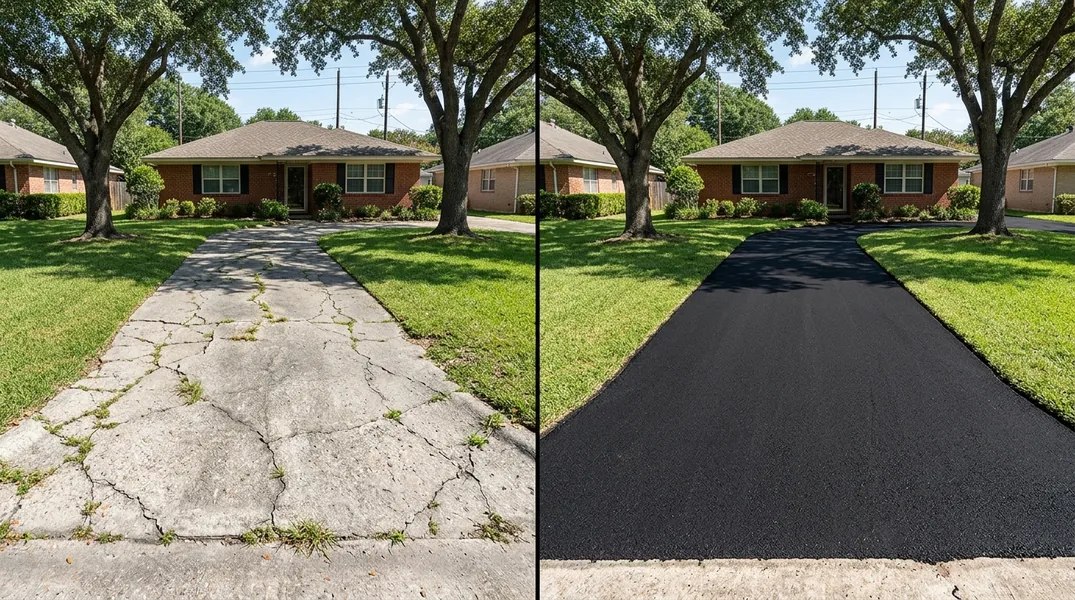
Understanding Houston's Gumbo Clay Challenge
Houston homeowners face a unique driveway dilemma that many other parts of the country don't encounter: gumbo clay soil. This heavy, expansive clay is notorious for shifting dramatically with seasonal moisture changes. When it rains, gumbo clay swells and pushes upward. During dry spells, it shrinks and creates voids beneath the surface. This constant movement is one of the primary reasons driveways in the Houston area develop cracks, heaves, and premature damage.
Before choosing between asphalt and concrete, it's essential to understand how each material responds to this geological reality. The soil beneath your driveway isn't just a foundation; it's an active force that will either support or undermine your investment. Proper site preparation and material selection become critical when building on gumbo clay, and this is where the asphalt versus concrete debate takes on special importance for local homeowners.
Asphalt vs Concrete Driveway: Performance in Gumbo Clay
When comparing asphalt vs concrete driveway options for Houston properties, flexibility is the key advantage asphalt holds. Concrete is rigid and brittle. When gumbo clay shifts beneath a concrete slab, the material cracks rather than flexes. These cracks begin as hairline fractures but quickly expand as water infiltrates the subsurface, accelerating deterioration. Concrete driveways in Houston often show signs of distress within 5 to 10 years due to this soil movement.
Asphalt, by contrast, is a flexible material that can accommodate minor ground movement without cracking. The blacktop surface shifts slightly with soil changes rather than fracturing under stress. This flexibility doesn't mean asphalt is immune to gumbo clay problems, but it handles the challenge more gracefully. When properly installed with adequate base preparation and compaction, an asphalt driveway can maintain structural integrity through multiple cycles of clay expansion and contraction. This fundamental difference in material behavior makes asphalt the superior choice for most Houston homeowners dealing with gumbo clay.
Asphalt Driveway Lifespan in Houston's Climate
The asphalt driveway lifespan in Houston typically ranges from 15 to 20 years with proper maintenance, though some well-maintained driveways last 25 years or longer. This lifespan is competitive with concrete when you factor in repair costs, and asphalt offers distinct advantages in a climate like Houston's. The region's hot, humid summers and heavy rainfall create conditions that stress rigid materials like concrete but allow flexible asphalt to perform effectively.
Regular maintenance is the secret to maximizing your asphalt driveway lifespan. Seal coating every two to three years protects the surface from UV damage and water penetration. Timely Driveway Repair of small issues prevents them from becoming expensive problems. Pothole Repair & Asphalt Patching should be addressed promptly to prevent water from reaching the base layers. When you invest in preventive care, an asphalt driveway becomes an economical long-term solution. Many Houston homeowners find that the lower initial cost of asphalt, combined with its extended lifespan and repairability, makes it a smarter investment than concrete.
Asphalt Over Concrete Driveway: When Overlay Makes Sense
If you already have a concrete driveway showing signs of distress from gumbo clay movement, you may be wondering about your options. Asphalt over concrete driveway installation, also called an asphalt overlay, is a viable solution that can extend the life of your existing surface without complete removal. This approach involves placing a new layer of asphalt directly over the concrete, which can work well if the concrete hasn't developed severe heaving or multiple large cracks.
However, there are important limitations to consider. If the underlying concrete is severely cracked or heaved due to soil movement, an overlay will eventually mirror those problems as the base continues to shift. The overlay may temporarily hide the damage, but it won't address the root cause. Asphalt Resurfacing & Overlay works best when the concrete base is still relatively stable. For many Houston homeowners with older concrete driveways, complete removal and replacement with a properly prepared asphalt base is the more durable long-term solution. A professional evaluation can determine whether an overlay is appropriate for your specific situation.
Blacktop Driveway Installation: Proper Base Preparation is Critical
The difference between a blacktop driveway that lasts 20 years and one that fails in 10 comes down to base preparation. In Houston's gumbo clay environment, the foundation beneath the asphalt is just as important as the asphalt itself. A proper base typically consists of 4 to 6 inches of compacted crushed stone or aggregate, which provides drainage and distributes weight evenly. This base layer must be thoroughly compacted to prevent settling and to create a stable platform that can flex slightly as the soil beneath moves.
Inadequate base preparation is the primary reason some asphalt driveways fail prematurely in the Houston area. When contractors cut corners and install asphalt directly on poorly compacted soil or minimal base material, the driveway lacks the structural support needed to handle gumbo clay movement. This leads to premature cracking, rutting, and alligatoring. Asphalt Driveway Paving & Installation requires attention to these details. Choosing a reputable local contractor who understands Houston's soil conditions ensures your driveway receives the proper foundation it needs to perform well for decades.
Asphalt Driveway Paving & Installation Cost in Houston: What to Budget
When evaluating asphalt vs concrete driveway options, cost is a significant factor. Asphalt typically costs $3 to $7 per square foot for Asphalt Driveway Paving & Installation, while concrete generally runs $6 to $12 per square foot. For a 500-square-foot driveway, asphalt might cost $1,500 to $3,500, whereas concrete could run $3,000 to $6,000. However, these initial pricing differences don't tell the complete financial story.
Over a 20-year period, total cost of ownership often favors asphalt when you account for maintenance and repairs. Concrete driveways in Houston frequently require expensive repairs or replacement due to gumbo clay movement, while asphalt's flexibility minimizes major damage. Seal coating, minor patching, and occasional resurfacing cost far less than concrete repair or replacement. If you're concerned about the investment, Houston Asphalt Paving offers a free estimate so you can compare your options with accurate local pricing information. Call us at (832) 956-1892 to discuss your driveway needs and get a detailed quote for your property.
Looking for a professional asphalt paving contractor in Houston? Houston Asphalt Paving responds fast for all your asphalt paving needs.
Get a Free Quote